Introduction
We've all been there during customer feedback audits.
A buyer finds a stunning pair of earrings from your store. They look perfect. The retail price point is ideal.
Then, within two hours of putting them on, their earlobes are hot, inflamed, and turning a concerning shade of red.
This is a complete brand killer. It directly triggers negative Shopify reviews, high product return rates, and expensive PayPal chargebacks.
This is exactly why high-intent keywords like "hypoallergenic jewelry", "best earrings for sensitive ears", and "surgical steel nickel release compliance" have achieved massive search volumes on Google B2B networks.
If you are a jewelry brand founder, boutique owner, or high-volume wholesaler sourcing inventory from China, you've likely seen stainless steel everywhere.
But is stainless steel hypoallergenic for earrings? Or is it just clever factory marketing?
As a premier OEM/ODM stainless steel jewelry manufacturer, Ducaibo Jewelry breaks down the direct metallurgy, international regulatory safety standards (like EU REACH), and advanced manufacturing secrets that determine whether a piece of jewelry will scale your repeat customer rate or ruin your brand's digital reputation.
Is Stainless Steel Jewelry Truly Hypoallergenic?
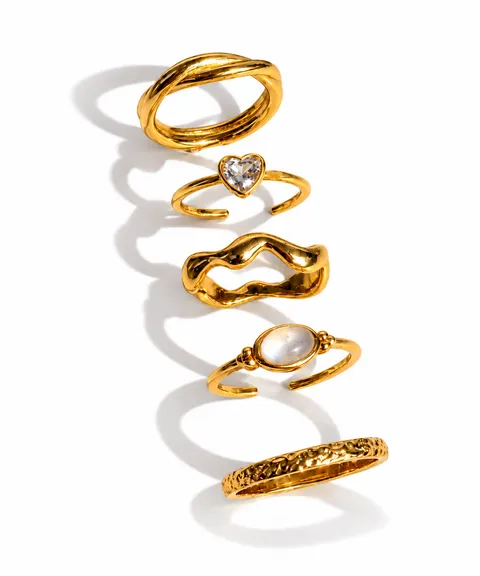
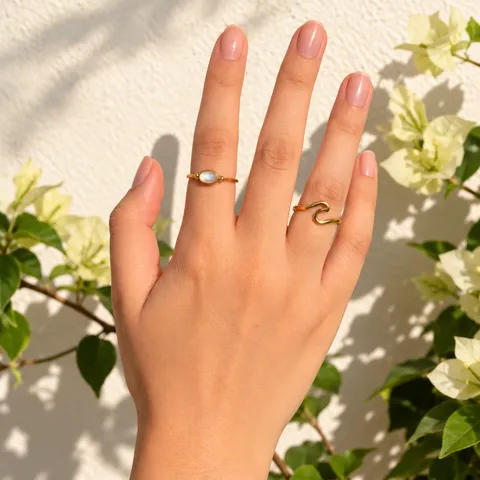
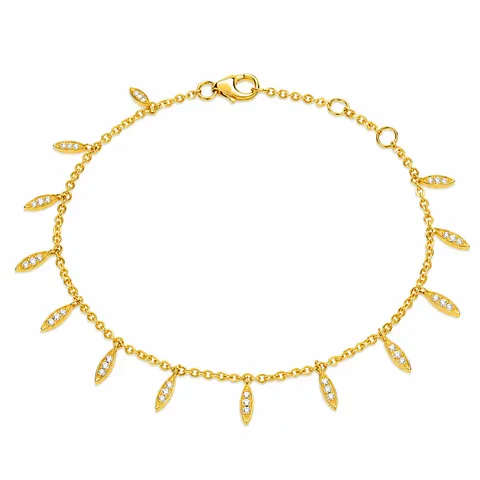
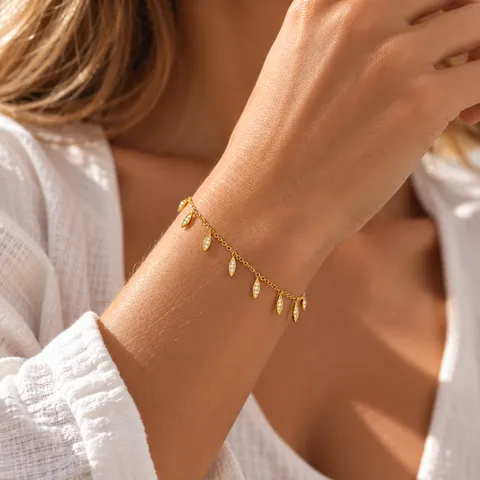
Instead of focusing only on earrings, it's important to understand that hypoallergenic performance applies to all types of stainless steel jewelry, including earrings, necklaces, rings, bracelets, anklets, body jewelry and charms.
For jewelry brands, choosing certified 316L stainless steel means offering safer products across an entire collection—not just earrings.
To protect your supply chain, we must first clarify what "hypoallergenic" actually means under international commercial trade standards.
Contrary to consumer belief, it does not mean "zero chance of an allergic reaction." Instead, it translates to "below average" or "slightly allergenic."
It is a verifiable chemical claim that the base metal is significantly less likely to cause contact dermatitis compared to nickel-heavy brass, zinc alloys, or low-grade fashion mixtures.
For the vast majority of the global population, stainless steel — specifically the premium medical grades engineered for jewelry production — is remarkably bio-compatible.
It is a robust, corrosion-resistant alloy that doesn't oxidize or turn skin green under daily wear.
However, because everyone's skin chemistry is entirely unique, a tiny percentage of highly sensitive consumers might still experience irritation.
The underlying cause isn't usually the steel iron matrix itself, but rather the raw material grading and the trace elements hidden within its crystalline structure.
When you partner with a verified factory for your supply chain, you are investing in an alloy that has been molecularly optimized to prevent these irritants from migrating into the human body.
Understanding the "Nickel Paradox" in Surgical Stainless Steel
Here is the raw industrial reality that many low-cost trading brokers and unverified factories try to hide: almost all stainless steel contains nickel.
Yes, even the premium grades labeled as "surgical steel."
This creates what metallurgists call the "Nickel Paradox." How can a brand safely and legally market an alloy containing a known allergen as completely safe for sensitive ears?
It all comes down to chemical bonding and the nickel release rate — rather than the raw percentage of nickel inside the metal composition.
text
[Cheaper 304 Steel]     → Unstable Passive Layer → Heavy Nickel Migration → Allergic Reaction & Returns
[Ducaibo 316L Steel]    → Solid Chromium Shield  → Nickel Atomic Lock    → 100% Hypoallergenic Safety
In high-purity stainless steel, the nickel atoms are trapped so tightly within the austenitic crystalline lattice that they are locked at the molecular level.
If the nickel cannot physically leach onto the skin, it cannot trigger an allergic reaction.
To satisfy international customs and compliance, serious e-commerce brands must bypass generic supplier promises and focus on strict scientific thresholds:
The Passive Shield: High-quality steel forms a self-healing chromium oxide passive layer. As long as this layer remains stable, the nickel remains completely locked inside.
The 12% Factor vs. REACH Compliance: While surgical steel may contain 10% to 14% nickel by composition, what matters to customs inspectors and dermatologists is the migration rate. According to the stringent European REACH Regulation (Annex XVII) and EN 1811:2011 standard, jewelry passing through pierced ears must have a nickel release rate of less than 0.05 μg/cm²/week.
Corrosion Resistance: Human sweat is highly saline and acidic. If your manufacturer substitutes cheap 304 steel, sweat will cause microscopic pitting, breaking the atomic shield and allowing nickel ions to leak out.
Which Stainless Steel Jewelry Is Best for Sensitive Skin?
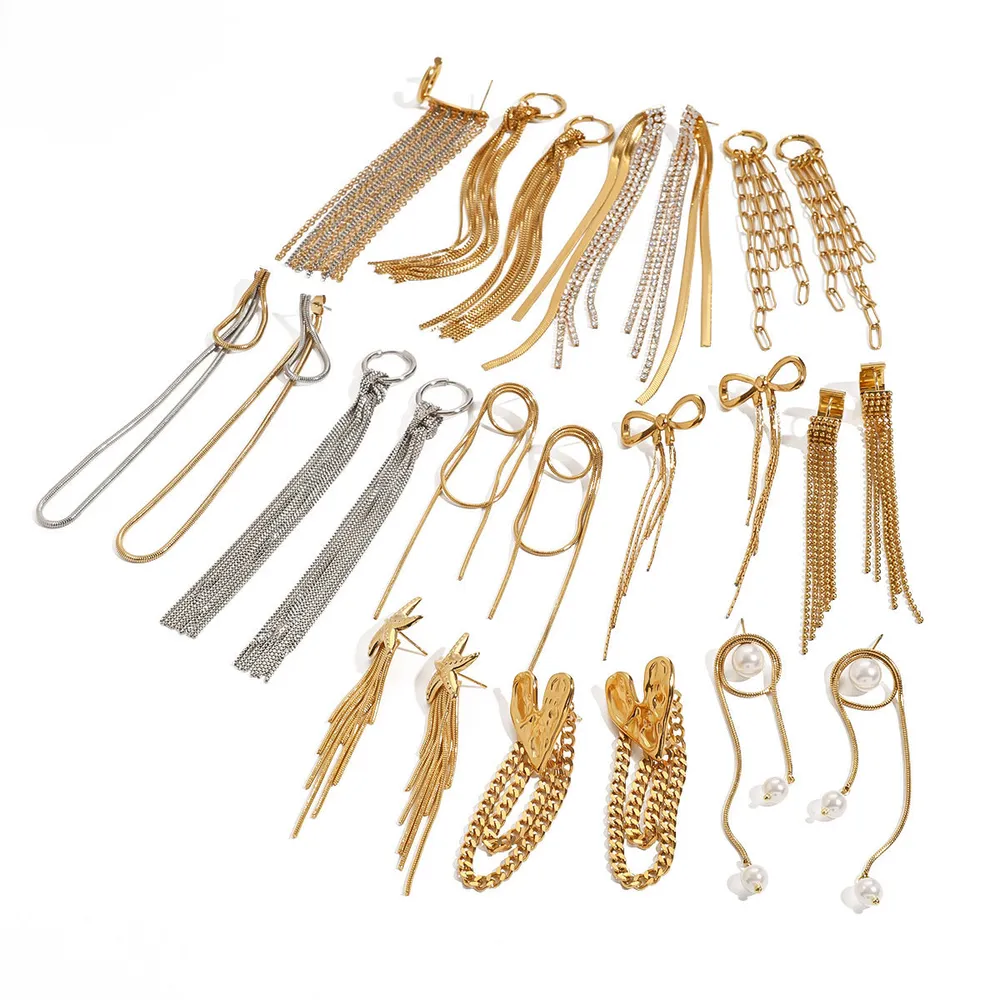
If you're developing jewelry collections for sensitive skin customers, 316L stainless steel is recommended for:
✔ Hoop Earrings
✔ Stud Earrings
✔ Necklaces
✔ Pendant Necklaces
✔ Stackable Rings
✔ Open Rings
✔ Tennis Bracelets
✔ Bangles
✔ Anklets
✔ Charms
✔ Layering Jewelry
This allows brands to build a complete hypoallergenic jewelry collection using the same certified material.
Why 316L Stainless Steel Is the Gold Standard for Jewelry
316L stainless steel is widely used for:
Earrings
Necklaces
Rings
Bracelets
Anklets
Belly Rings
Nose Rings
Charms
Pendants
This versatility makes it the preferred material for fashion jewelry brands worldwide.
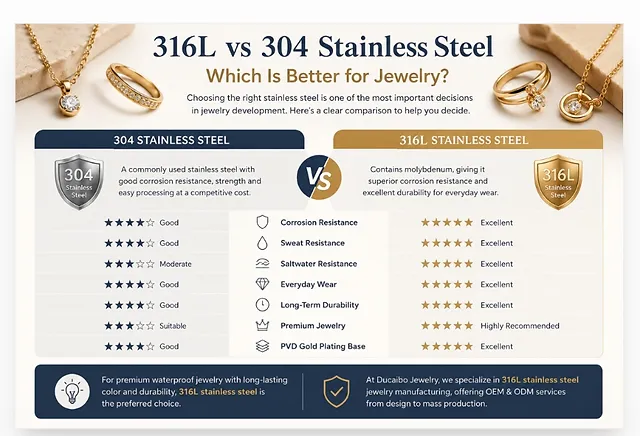
When auditing your factory's tech packs and material specifications, seeing "316L" is your ultimate guarantee of medical-grade quality.
Not all steel is created equal, and 316L is the specific alloy required for any accessory that passes directly through human tissue.
1. Ultra-Low Carbon Content ("L")
The "L" in 316L stands for "Low Carbon" — specifically restricted to under 0.03%.
This metallurgical restriction prevents a phenomenon called carbide precipitation during high-heat factory processes like investment casting or laser welding.
By keeping carbon low, the earring posts and hoops retain maximum structural integrity and corrosion defense.
2. The Molybdenum Advantage
316L contains approximately 2% to 3% molybdenum. This is the critical element missing from cheaper industrial steels like grade 304.
Molybdenum drastically elevates the metal's resistance to chloride pitting, ensuring the earring surfaces remain perfectly smooth so bacteria, sweat, and cosmetic residue have nowhere to hide.
3. High Bio-compatibility
While not an absolute bio-material like ultra-premium pure titanium, 316L is widely trusted in the medical field for manufacturing non-permanent internal devices, bone screws, and pharmaceutical pipelines.
The humFan body generally ignores its presence.
Unlike sterling silver, which can occasionally react with body chemistry and leave permanent dark cosmetic marks (argyria) inside a piercing hole, 316L remains entirely inert over years of continuous wear.
While the raw material grade sets the foundation, the real differentiator for your brand's reputation lies in how that material is manufactured. This is where Ducaibo's engineering excellence takes over
Material Showdown: Surgical Steel vs. Titanium vs. Other Metals
When retail buyers shop your online store for sensitive skin earrings, they frequently run comparisons between surgical steel, titanium, and precious metals.
To help brand managers evaluate their manufacturing budget against consumer sensitivity risks, we have compiled the definitive B2B comparison table below:
| Material Type | Avg Nickel Content | Price Point | Allergy Risk | Durability | Best For |
| 316L Stainless Steel (Ducaibo) | 10–14% (Locked Matrix) | Affordable / High-Margin | Extremely Low | Maximum (Lifetime) | Premium Brands, Daily Wear, Waterproof Lines |
| 304 Stainless Steel | 8–10% (Unstable Shield) | Budget / Low-Cost | Moderate | High (Surface degrades) | Fast Fashion, Short-term Promotional |
| Titanium (Grade 23) | 0% | Premium / High | Absolute Zero | Exceptional | Initial Piercings, Severe Metal Allergies |
| 14K Gold Alloys | Varies (often contains zinc) | Luxury / High | Low to Moderate | Moderate | Luxury Fine Jewelry |
| Sterling Silver (.925) | 0% (contains 7.5% Copper) | Moderate | Moderate | Low (Tarnishes fast) | Traditional Editorial Jewelry |
The Ducaibo Manufacturing Factor: How We Guarantee High Safety Standards
If the raw material grades are standard, why do some stainless steel earrings still cause customer complaints while others perform flawlessly?
The answer lies entirely within the factory's manufacturing precision. High-performance safety is a product of engineering, not just raw material sourcing.
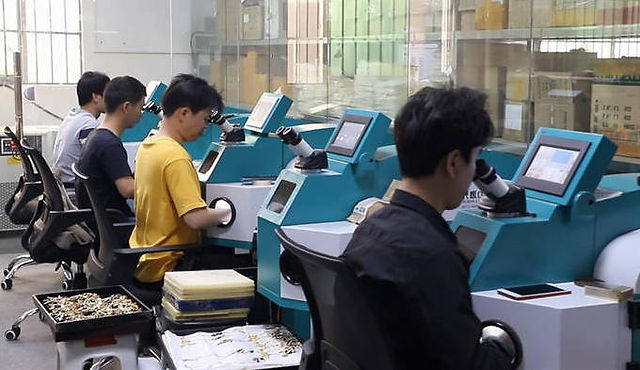
At Ducaibo Jewelry, our state-of-the-art production facility utilizes three strict quality-assurance protocols to safeguard the hypoallergenic integrity of every wholesale batch.
1. High-Purity Vacuum Melting (316LVM Quality Control)
Instead of using standard scrap steel or unverified raw material tubes, we source high-purity, vacuum-melted 316L steel.
This specialized process eliminates trace gaseous impurities and non-metallic inclusions, ensuring the self-healing chromium oxide passive layer is 100% structurally uniform across the entire surface of the earring post.
2. Advanced PVD Vacuum Plating
Traditional electroplating methods often use a nickel-based intermediate layer to improve the adhesion between the base metal and the gold finish. For jewelry designed for sensitive skin, this additional layer may increase the risk of nickel exposure if the coating becomes compromised over time.
To minimize this risk, Ducaibo Jewelry applies advanced Physical Vapor Deposition (PVD) technology in a controlled vacuum environment.
Unlike conventional electroplating, PVD is a dry coating process that forms a dense, highly stable surface through molecular bonding. This process helps create an additional protective barrier between the stainless steel substrate and the wearer's skin, while also improving the coating's resistance to daily wear.
For jewelry brands developing hypoallergenic collections, combining certified 316L stainless steel with advanced PVD technology provides an additional level of protection, durability, and product consistency.
3.Surface Engineering & Human-Centered Design
Beyond material selection, the way jewelry is finished and engineered plays an equally important role in wearer comfort and long-term performance.
Even the highest-grade 316L stainless steel can cause discomfort if the surface is poorly polished or the structure is not designed for daily wear. Rough edges, microscopic burrs, or uneven finishing may create friction against the skin, leading to irritation that customers often mistake for a metal allergy.
At Ducaibo Jewelry, every piece undergoes multiple stages of automated polishing followed by precision hand finishing to achieve a flawless mirror surface. This not only enhances the appearance of the jewelry but also minimizes skin friction and improves overall wearing comfort.
Equally important is structural engineering. Different jewelry categories require different design considerations to ensure comfort without sacrificing aesthetics:
Earrings: Lightweight construction reduces pressure on pierced ears and minimizes pulling during extended wear.
Rings: Smooth inner surfaces and ergonomic profiles provide a comfortable fit for everyday use.
Necklaces & Pendants: Balanced pendant weight and carefully matched chain proportions help prevent twisting and improve daily comfort.
Bracelets & Anklets: Rounded edges, flexible links, and optimized dimensions reduce friction during movement.
For larger statement pieces, such as oversized hoops, bold rings, chunky bracelets, or heavy pendants, Ducaibo applies specialized lightweight engineering—including hollow-structure technology where appropriate—to reduce unnecessary weight while maintaining the desired visual impact.
By combining mirror polishing, ergonomic design, and precision manufacturing, we help jewelry brands create collections that are not only beautiful but also comfortable enough for customers to wear every day.
How to Tell Whether Jewelry Irritation Is a Metal Allergy
Customers may experience irritation after wearing:
Earrings
Rings
Bracelets
Necklaces
Anklets
Knowing the difference between a genuine nickel allergy and simple skin irritation helps jewelry brands reduce unnecessary returns.
For brand owners and customer support teams, knowing how to diagnose product feedback is essential for maintaining brand equity.
If a customer reports that their ears are acting up, use this quick checklist to determine whether they are dealing with true metal contact dermatitis or a basic mechanical/hygiene issue.
| Symptom | True Nickel Allergy | Mechanical Irritation |
| Persistent, intensive itching inside piercing track | ✅ Yes | ❌ No |
| Eczema-like flaking or peeling skin | ✅ Yes | ❌ No |
| Clear serous fluid weeping (not pus) | ✅ Yes | ❌ No |
| "Heat" sensation — ear feels hot to touch | ✅ Yes | ❌ No |
| Redness goes away within 24-48 hours of removal | ✅ Yes | ❌ No |
| Irritation persists after removal | ❌ No | ✅ Yes (likely infection or tear) |
The Quick B2B Diagnostic Solution: Ask your customer support team to have the buyer remove the earrings for 24 to 48 hours.
If the redness, swelling, and itching completely subside without antibiotic creams, the customer is experiencing a metal allergy caused by high nickel release from low-grade metal.
If the irritation remains, it is likely a bacterial infection or mechanical tearing from an overweight earring (over 7 grams) sourced from a non-specialized factory.
❓ Top Hot-Searched Questions Asked by Western Jewelry Buyers (B2B FAQ)
Q: Is "Surgical Steel" exactly the same as 316L Stainless Steel?
A: "Surgical steel" is a broad commercial marketing term, not an official metallurgical classification. While high-quality surgical steel is usually grade 316L or 316LVM, some low-end suppliers use the term to mask grade 430 or 304 steel. When sourcing, never accept "surgical steel" as a written specification. Always insist on the exact grade designation: 316L Stainless Steel.
Q: How does Ducaibo guarantee compliance with EU REACH and California Prop 65 for nickel release?
A: We enforce a two-tier verification protocol. First, every batch of raw steel undergoes XRF testing to ensure medical standards. Second, we routinely send finished production samples to independent certification bodies like SGS and Intertek. We provide official laboratory test reports confirming a nickel release rate well below the 0.05 μg/cm²/week threshold.
Q: If 316L contains 10-14% nickel, can I market my earrings as "Nickel-Free" in the US and Europe?
A: Legally, the FTC (US) and REACH authorities (Europe) prefer the term "Hypoallergenic" or "Nickel-Safe" rather than "Nickel-Free" for stainless steel. Because nickel is chemically present in the alloy, labeling it "Nickel-Free" can trigger legal technicalities. Marketing as "Hypoallergenic and Compliant with EU Nickel-Safe Standards" is the safest, highest-converting strategy.
Q: Does custom PVD gold plating affect the hypoallergenic properties?
A: Our PVD coating actually enhances safety. Unlike traditional electroplating which often uses a hidden nickel bonding layer, Ducaibo's PVD process uses titanium nitride and real gold vaporized in a clean vacuum chamber. This creates a dense, biocatalytic barrier that adds an extra physical shield — keeping earrings 3+ years tarnish-free and completely safe for reactive skin.
Q: Why do some stainless steel earrings cause irritation even if the supplier claims it is 316L?
A: This is almost always caused by poor surface finishing or improper weight distribution, not a chemical allergy. If a factory skips micro-mirror polishing, invisible microscopic burrs scratch the delicate skin inside the piercing. If earring weight exceeds 7 grams without hollow-tube optimization, physical gravity pulling causes soreness that consumers mistake for a metal allergy.
Q: Can my customers wear Ducaibo's 316L earrings in the ocean, swimming pools, and showers?
A: Absolutely. Thanks to the 2-3% molybdenum content in our 316L steel matrix and our advanced PVD vacuum adhesion, our jewelry lines are completely waterproof, sweat-proof, and pool-proof. The passive chromium layer instantly self-heals when exposed to oxygen, protecting earrings from pitting or corroding in saltwater or chlorine.
Supply Chain Tips for Wholesale Buyers and Brand Managers
To maximize your brand value, protect your margins, and maintain a flawless customer retention rate, integrate these technical strategies into your product management workflow.
Tip 1: Incorporate Clear Ingredient Marketing
Don't just tag your earrings as "metal jewelry." Leverage highly searchable, high-converting descriptions on your Shopify product pages, such as:
"Crafted from Certified 316L Surgical Stainless Steel | 100% Hypoallergenic | Compliant with EU REACH Standards."
Tip 2: Educate on "Pseudo-Allergies" via Packaging
Trapped moisture, sweat, and soap residue behind flat-back earrings can cause skin maceration — which looks identical to an allergic rash but is actually a hygiene issue. Provide a quick cleaning card with your packaging stating: "The cleaner the jewelry, the safer the skin."
Tip 3: Enforce Batch Auditing
Always require your manufacturing partner to provide verified Mill Test Reports (MTR) and independent SGS or Intertek nickel-release certifications (EN 1811) with your production runs to protect your supply chain from material substitution.
Conclusion
Is stainless steel hypoallergenic for earrings?
Yes — provided you are sourcing verified, precision-manufactured 316L surgical steel from an engineered facility.
When refined under strict industrial standards, polished to a mirror finish, and decorated using advanced PVD plating, 316L stainless steel remains the most durable, cost-effective, and safe material available for the global fashion jewelry industry.
At Ducaibo Jewelry, we turn metallurgy into market-leading collections. We specialize in high-purity 316L stainless steel manufacturing, offering full OEM/ODM support, custom logo branding, and certified nickel-safe compliance for scaling global brands.
📚 Continue Exploring Our Stainless Steel Jewelry Knowledge Hub
This article is part of our Stainless Steel Jewelry Learning Center, where we share technical guides, manufacturing insights, jewelry material comparisons, OEM development knowledge, and market trends for jewelry brands worldwide.
👉 Browse the Complete Stainless Steel Jewelry Knowledge Hub
📚 Related Articles
**.Why Stainless Steel Jewelry Is Perfect for Everyday Wear
***316L vs 304 Stainless Steel Jewelry: A Practical Guide for Jewelry Brands
**Custom Stainless Steel Jewelry Manufacturer:Complete Guide for Brands & Designers
📩 Build a Complete Hypoallergenic Jewelry Collection
Whether you're developing:
✔ Earrings
✔ Necklaces
✔ Rings
✔ Bracelets
✔ Anklets
✔ Jewelry Sets
Ducaibo Jewelry helps brands manufacture premium 316L stainless steel jewelry with OEM & ODM services, PVD gold plating, and international compliance standards.
| Jewelry Type | 316L Stainless Steel | Suitable for Sensitive Skin |
| Earrings | ✅ | Excellent |
| Rings | ✅ | Excellent |
| Necklaces | ✅ | Excellent |
| Bracelets | ✅ | Excellent |
| Anklets | ✅ | Excellent |
| Charms | ✅ | Excellent |
Partner with a factory that values quality, compliance, and human ergonomics as much as you do. Connect directly with our development team today to explore how we can bring your next collection to life.
What We Offer:
| Feature | Details |
| ✅ Low MOQ Programs | Custom logo customization starting at just 100-200 pieces per design,100-200pcs per ring size |
| ✅ Full Documentation | Authentic Mill Test Reports (MTR) provided with every batch |
| ✅ Lifetime Finishes | Multi-stage hand polishing with tarnish free PVD plating |
| ✅ Fast Prototyping | Sample prototyping in 15–25 days |
| ✅ Compliance | REACH, RoHS, Prop 65, Nickel Release (EN 1811) Certified |

Get in Touch:
📬 Direct Email Inquiry: ivyli@ducaibojewelry.com
💬 WhatsApp Corporate Support: +86 136 5268 0103
🌐 Visit Our Factory Website: www.ducaibojewelry.com
Send us your design sketches or custom tech packs today, and let's construct your brand's next best-selling collection together.
Recommended Internal Links